Last week, the Detroit Free Press ran an article titled “More pets, fewer vets bring strain on veterinary profession.” This crisis has been snowballing over recent years and not only impacts the animal welfare industry but each of us individually and our communities as a whole. The article frames the vet shortage as a threat to the industry, but the reality is that it is a threat to families and what we hold dear.
Roughly 70% of Americans have pets, a growing trend, yet the ability to care for those pets is becoming more challenging. The issue is a product of many issues; wage disparity, significant debt, burn out, lack of enough academic institutions, among many other factors.
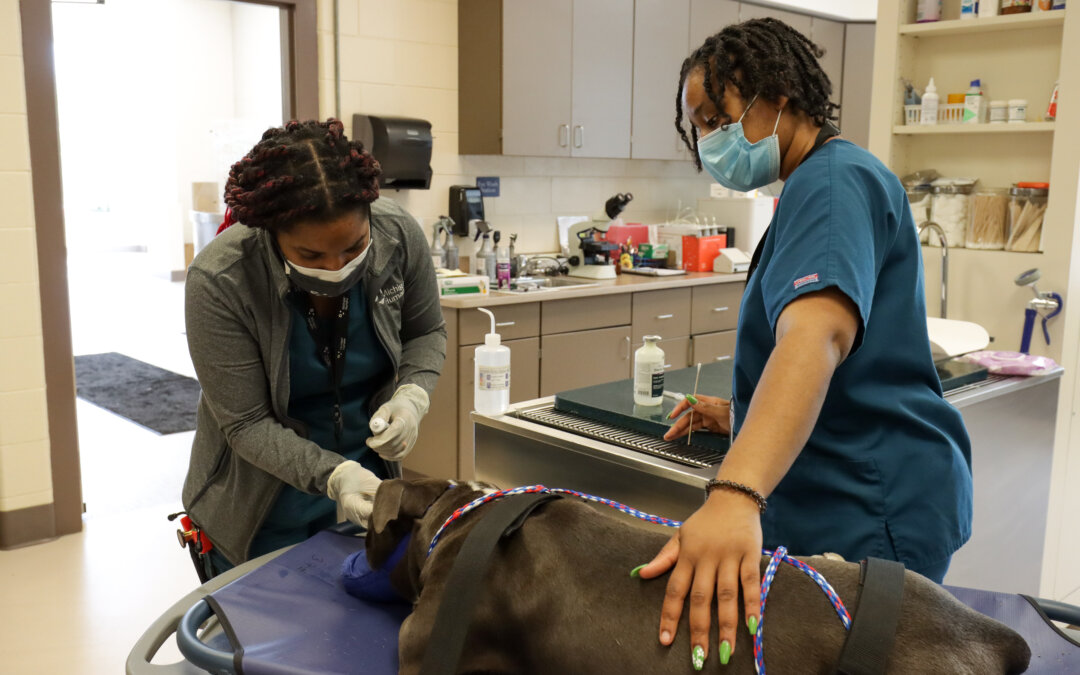
At Michigan Humane, we recognize – and are feeling the impact – of this crisis in veterinary medicine. Attracting and retaining talent is more challenging, sourcing vets has become much more competitive, and, frankly, there are just more jobs and more need than there are veterinarians or licensed veterinary technicians.
While we know it is only a part of the solution, we have been working towards developing veterinary talent in Detroit with our high school programs for years that provide exposure to veterinary medicine as a career. Beyond high school, we offer a robust summer jobs program providing critical experience to first-year and second-year pre-vet students. To help upcoming graduates to hit the ground running, we offer veterinary externships for third-year and fourth-year pre-vet students.

In addition to those opportunities, we have a licensed veterinary technician apprentice program in conjunction with Penn Foster. The program provides real world experience while working with Michigan Humane, under a mentor, towards a career as a licensed veterinary technician. These initiatives support the vision of developing future talent and keeping them here in Detroit to serve the needs of the community. While incredibly impactful, these programs do not fully address the larger, more complex, issue.
We cannot do it alone. We are honored to announce that Michigan Humane received $500,000 from The Vera and Joseph Dresner Foundation to support our Humane Communities’ Thriving Workforce and Economy initiative, focusing on our veterinary education programs.
Veterinarians are critical to our work and our vision for Detroit. They are necessary for our community clinics and our community veterinary program – bringing veterinary services into the community. Access to care is the cornerstone of our initiative towards making Metro Detroit the most humane community in the country by 2030.
What more can we do about it?
In order for Detroit to be the community we want it to be, the pets of this city need to be supported. In the absence of this support, people will sacrifice their own needs for that of their pet. We need to continue to drive future leads towards a career in veterinary medicine. This can’t happen unless we continue to open pathways and allow those interested to see themselves in the work. Detroit can be a hub for veterinary talent in the country.
Many states are discussing the implementation of a mid-level practitioner in veterinary medicine to add much needed assistance to existing veterinarians by carrying much of the burden they now have; therefore extending their impact. Think of a nurse practitioner but in veterinary medicine. We are working with local and national resources to explore this.
We need to build more opportunities for students to pursue a career as a Licensed Veterinary Technician. They are just as critical as veterinarians in the day-to-day work and there are not enough here to meet the needs in our communities. We are working with current and potential future academic institutions to address this.
Legislatively we can work to create debt relief so future veterinarians and licensed veterinary technicians aren’t hampered by crippling debt and a salary that isn’t in accordance with the debt. Along with this, employers, Michigan Humane include, need to compensate veterinarians and licensed veterinary technicians at a more competitive rate. This has been a consistent item on our list of academic priorities.
This is a complex issue and does not have an overnight solution. Michigan Humane is committed to working with stakeholders and being a part of the solution. Veterinary talent is critical to who we are and what we do and to pet owners throughout Metro Detroit, regardless of their socio-economic status.
As a community we need your support to meet the need as it exists now, while working towards a more sustainable model of veterinary care – that all have access to. In addition, our work in the community is expanding and is designed to catch issues before they become serious medical needs. Hopefully, this will reduce the burden on an already overwhelmed system.
Photo Credit: Michigan Humane